This week in science ten we were discussing adaptations and speciation. What constitutes a species is one of those messy areas in biology. A species is defined as a group of related organisms that interbreed with each other. The definition is relatively straightforward, but given how evolution occurs the boundaries are going to be fuzzy.
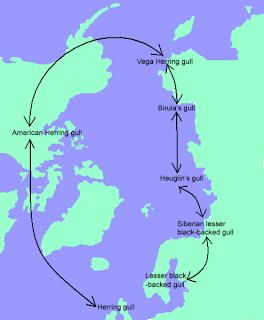 An example of the problem is a ring species such as the Laras gull. These gulls exist as separate geographical populations, and each can interbreed with its neighbour.
Gull A can interbreed with Gull B which can interbreed with Gull C which can interbreed with Gull D which can interbreed with Gull E. These are stable populations, and you might expect that they are all the same species, except that Gull E cannot breed with Gull A.
Yah. The first time I understood what that meant my head exploded just a little bit. We often think of our evolutionary lineage extending back to a common ape-like ancestor, with some sort of 'missing link'. Except, if you understand evolution, you understand that species are not separated by discrete 'links', but by slight variation. This makes a bit more sense if you think of following your family tree backwards. First you meet your parents, then your grandparents, then your great-grandparents, great-great-grandparents, and so on. Richard Dawkins suggests that if you go back approximately 250,000 greats you'll meet the common ancestor for chimps, bonobos and humans. Every step of that journey, meeting each one of your ancestors, there were none that would be considered a separate species from those immediately before or after. Yet the difference between the beginning and the end is that of a different species. There's sometimes a misconception within popular culture that a new species arises when a baby is born that has significantly new abilities from its parents, and that needn't be the case. Each birth is a tiny step in a journey, and it's only when comparing the end points that the label of differing 'species' makes sense. While with the gulls the difference is one of genes and geography, with chimps and humans is one of genes and time.
There are species today in which this blurring of boundaries can still be seen. Donkeys and horses can breed and the offspring will either be a mule or a hinny. Donkey's and horses are close enough to interbreed, but it's still not quite close enough. Mules and hinnys are often sterile. The number of chromosomes in each species is different; donkeys have 62, and horses 64. This gives the mule 63, and the odd number usually prevents meiosis, which in turn causes sterility. Ligors and tigons are another example.
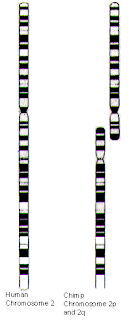
 Which, of course, brings up Oliver, the Humanzee or Chuman. Oliver is a chimpanzee that prefers to walk on two feet, and his physical appearances seemed to suggest a more human 'look' than was normal for chimpanzee's. Oliver also apparently like human females more than chimpanzee females. Naturally there has been speculation that he is a cross between a human and a chimpanzee. Since 94% of human and chimp DNA is identical, although chimpanzee's and humans share the same chromosome problem as donkey's and horses; humans have 46 and chimps have 48. This difference occurred as what is called chromosome 2 in humans is fused homologous version of 2 chromosomes in chimps. This piece of evidence for common ancestry played a small role in the Kitzmiller v. Dover case in the United States where
 So what about Oliver? Is he chimp, or is he something in between? Given the differences in chromosomes, it was not difficult to test this hypothesis. If chimps have 48 chromosomes, and humans have 46, then a confirmation of 47 chromosomes in Oliver would confirm his humanzee status. This test was performed, and Oliver has 48 chromosomes, and remains a cousin rather than a brother.
This example suggests the impact evolution is having on our society. Where we once saw species as separate and distinct, we now see them as continuous and related. Where humans were once considered the pinnacle of design, we are now just one twig of a giant tree, members of an enormous family. The science has been clear for a long time (150 years!), but it takes time for the meaning to permeate philosophy and culture. The excitement over Oliver is a reflection of our growing understanding that we are all, in fact, related.
Cheers,
Ron Neufeld
Canada's Best Boarding School
Update : Some students asked if there was a difference between a tigon and a ligor, or a humanzee or chuman. There is. Offspring of two different species have the name of the male species for the first half, and the name of the female species for the second half. So a 'tigon' is the result of a male tiger and a female lion. (Our culture has patriarchal roots, and I presume the 'male first' rule extends from this older cultural expectation.)


 Posts
Posts

